
A WOODY REFLECTION
A JOURNEY THROUGH MY MANY YEARS OF WOODWORKING

This post is intended to capture part of my legacy in woodworking - a memoir of sorts. The post is more for me than any of you readers so I apologize if you find it boring. You can at least enjoy the pictures. These pictures show furniture I have built throughout the last 40 some years as well as the story of my first furniture blunder and some other comments from my woodworking experience.
I received a message that this post is too long for email but I believe you will be able to somehow see the full post by clicking on “view the entire post.” If anything, go to dougdiehl.substack.com and there I believe you can see the whole thing.
I don’t remember when or how woodworking first got into my psyche. Although I built some simple things as a kid I was more interested in chemistry and electronics. I suppose some of that was because of spending time in my dad’s tool filled workshop in our basement. However, when my brother and I did spent any time down there it was to help organize the workshop (like sorting nails and screws) as well as to fool around with some interesting things left behind by the former owner who was a dentist - like a jar of mercury. The only major tool my dad had was a Shopsmith that had been left behind by that previous owner. If you don’t know what that is - it is a five-in-one power tool: table saw, drill press, horizontal borer, lathe and disc sander. Who knows how old it was. It came with the house when my parents moved in in the late 1950’s. It still exists today although I have passed it on.
I don’t remember my dad doing a lot of woodworking except for the time I watched and helped him make a divider for our small bathroom. It was also at that time that I learned how a good woodworker is able to cover up inevitable mistakes as my dad had drilled holes on the wrong side of a board but managed to cleverly hide it.
The main woodworker in our family was my dad’s dad. He was a farmer in southwest North Dakota but also a carpenter on the side. He built two closets in our house which impressed me as a small boy. He also built me and his other grandsons a tool chest.
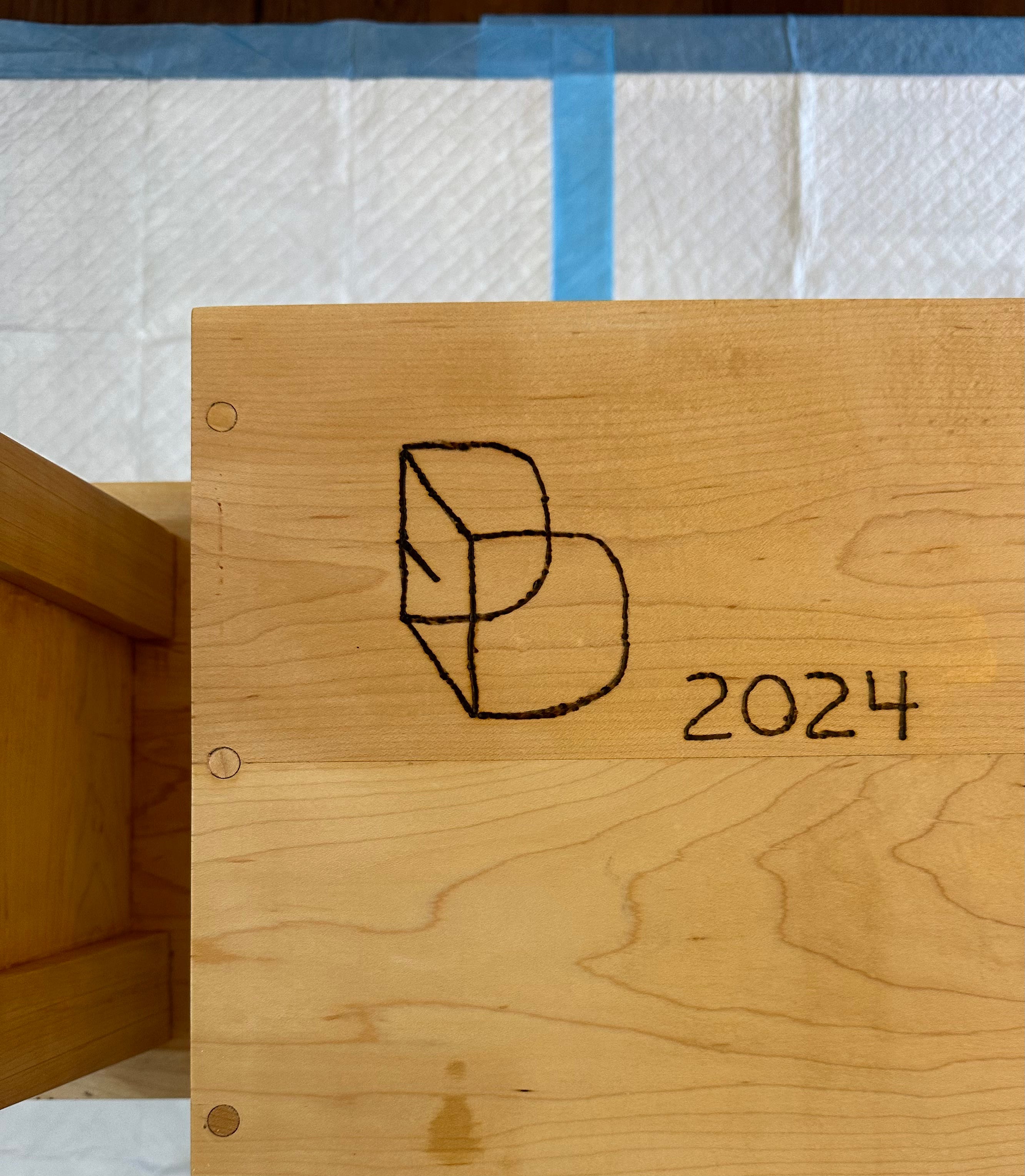
Again, although my dad didn’t do a lot of carpentry he had a foundational part to play in my woodworking. Above you see my brand that I woodburn into all of my projects. (I should have had a professional branding iron made because sometimes my woodburning is less than ideal, but it is what it is.) The D-D is most prominent - Doug Diehl - but you will also see on the left a small mark that produces an “E.” My dad’s name was and my middle name is Edwin. That little mark is very important as it honors my dad as well as it reminds me how he helped me get started through an initial project we had together.
So here’s the story behind that first project:
I was getting ready to graduate from seminary tin the spring of 1978 and Dawn and I were going to need furniture in whatever was to be our first home (parsonage). The previous fall we began visiting several furniture stores in Lexington, Kentucky to get some ideas of what we would want. As we looked around I was impacted by two realities - furniture was much more expensive than I expected and this expensive furniture was built much more cheaply than I anticipated. I think some of that was the result of visiting a former Shaker establishment near the seminary. You may be familiar with the Shaker style of furniture. If not, you may want to look into who the Shakers were and the furniture that was the inspiration for that specific style of furniture.
While visiting furniture stores we came across a canopy bed that caught our eye. I commented to Dawn - “I’ll bet I could build that” - and so it began. I drew up plans and called my dad to announce to him that he and I were going to build a canopy bed during my month long Christmas vacation.
After purchasing a stack of maple boards, our first order of business was to build the headboard (by the way, I am having difficulty finding a picture of that bed. If I could show you a picture this would all make more sense). The headboard was to be a 7’ high bookcase. It was a beautiful piece of workmanship my dad and I - all screwed and glued - and all built with the Shopsmith, in a fairly small basement workshop.
I called my mom to come downstairs and see it. As she looked it over, she commented, “You will never get that out of the basement.” We never even thought about that and since it was glued together there was no way we could take it apart if it didn’t fit. At first we didn’t believe her. We measured and remeasured and sure enough she was right. A steep stairway out of the basement as well as a closet my grandpa had built above the stairway made getting it out impossible. I’m sure I was mad and depressed and baffled but the day came we had to go back to seminary. I left my dad with these instructions, “You need to figure out a way to get this headboard/bookcase out of the basement by the time we get back after graduation.”
Lo and behold he did it! He had to remove the floor of the overhead closet and cut a piece out of a floor joist but he did it! We barely squeaked the headboard out of the basement.
It was an embarrassment at the time but a great story now.
From there I built several pieces of furniture which I will show in this post with some comment. Furniture building and carpentry became an important part of my life. I had an engineering mind and there is little place for that in pastoral ministry so this hobby gave me an outlet. It was also a good distraction for me as I dealt with the challenges of ministry. Whereas, as a pastor, I felt like I was never done I could legitimately have an area of life in which I could say, “it is finished!”
Here are some pictures of most of the furniture I have built over the years (except for that canopy bed that started it all):

We moved from Bismarck in 1980 to Rapid City. In both of these appointments I was an associate pastor. While in Rapid City I continued to fill my tool chest. I also bought my own Shopsmith. Back in those days one could see woodworkers demonstrating Shopsmiths in shopping malls. I believe it was the only way through which to purchase them as well. The Shopsmith is a major, quality made, heavy piece of machinery. It came to our house in a freight truck. That was an exciting day!
I only remember building one piece of furniture while living in Rapid City the first time (from 1980-1983). Our children were both born in Rapid and so when our son was getting old enough to have his own bed I built a set of bunk beds for him, eventually to include his sister. Unfortunately, I also can’t seem to find a picture of that bed.

In 1983 I was appointed to the Britton/Langford/Pierpont Parish. I now was on my own. It was a busy parish with a lot of driving, the kids were small, I was a volunteer fireman, and I did a lot of road bicycling but somehow I had enough time to do some major furniture making. The previous pastor’s wife had a pottery studio in one of the basement rooms so I was able to turn that into a workshop with my Shopsmith and a growing pile of hand tools. It was also during this time that I actually thought about leaving the ministry (my personality and the demands of pastoring wasn’t jiving for me very well) to become a professional furniture maker. Fortunately, the Holy Spirit and common sense won out. It would have been a hard way to make a decent living.
Here are the articles of furniture I built while living in Britton:


This chest on chest was probably the most aggressive project I have ever worked on. I made it from plans and did it all on my Shopsmith. I cut the dovetails by hand using a chisel, dovetail saw and mallet. It was painstaking. Some of the first dovetails were a little nasty looking but as I progressed with the drawers they got better and better. The finish (stain and final finish) was even a reproduction of how they did it in colonial times. If I could do it over again I would have left it with no stain and let the cherry do its thing - darken with age.
Speaking of cherry, I had tried working with some other woods and found that cherry was the easiest for me to work with and more importantly I was least allergic to cherry sawdust.

The above table is probably the project I am most proud of. The legs are hand shaped with the center spindle made on the Shopsmith lathe. Originally it was a true tilt top just like in the olden days. They made it that way so the top could tilt in a vertical position, be folded up and stored against the wall to save space. I actually made it permanent later on so it could no longer be tilted. We threw too many things to the floor when we would accidentally lean on it and flip the top.


This bed and side table were actually made from the maple that I used to build that infamous canopy bed that was stuck in my parent’s basement. In the middle picture I lifted the bedding to show the rope that provides the suspension for the mattress. One rope runs interwoven in both directions. Again, this is a reproduction. I eventually had to put a piece of plywood on top of the rope suspension so the mattress wouldn’t sag as much. The big challenge on these pieces of furniture was to duplicate accurately the turnings on the beside table and bed.


I believe I made the round oak side table in order to practice for the cherry tilt top above.
The reproduction cherry highboy is an interesting story. We moved from Britton, SD to Grand Forks, ND when I was in the middle of building the highboy. I had the main carcass constructed and had the cabriole legs rough cut with the band saw. At this time our daughter was 9 years old and it was for her I was building it. I didn’t have a place for a workshop in Grand Forks but a church member who farmed graciously offered me a corner in his very large shop. Unfortunately, I did not have a lot of time for wood working so I made very slow progress on the highboy. After seven years we moved the highboy carcass and the rough cut cabriole legs to Bismarck. Our daughter was now 16 and still no highboy. I was a district superintendent for three years with no time and space to do any woodworking so the unfinished highboy moved with us to Rapid City in 2001. Our daughter was now 19 years old. Although I had a nice workshop I did very little major woodworking during the 12 years I was at Rapid City First. Then I retired. Our daughter was now 31 years old, married with children. I finally finished the highboy. So I figure it took me over 30 years to get it done. But it sure is beautiful. I think one of the issues going on that led to a lot of procrastinating with this highboy was I was afraid of duplicating the four legs. After the rough cut on the bandsaw 30 years earlier they all had to be hand-shaped to match with knives and files.
These are some of the major projects I have done since retiring. Along with them I also did various smaller projects for ourselves and for others.


I end with my latest project just finished a few weeks ago. Dawn and I designed this chest of drawers and I began the project in the spring of 2023. The carcass is made of hard rock maple and is incredibly heavy - so heavy I made it to come apart in two pieces. The major challenge for the carcass was figuring out a way for the tapered, slanted legs to be capable of holding all of the weight. The drawer fronts are made from combinations of maple, ash, quarter-sawn oak, cherry, walnut and African mahogany.
What comes next? I have no idea.
Thanks, Dale. Woodworking has always been a great escape. It is interesting to reflect on the transition from Colonial reproduction to very contemporary.
Wow. You have lots of talents.